
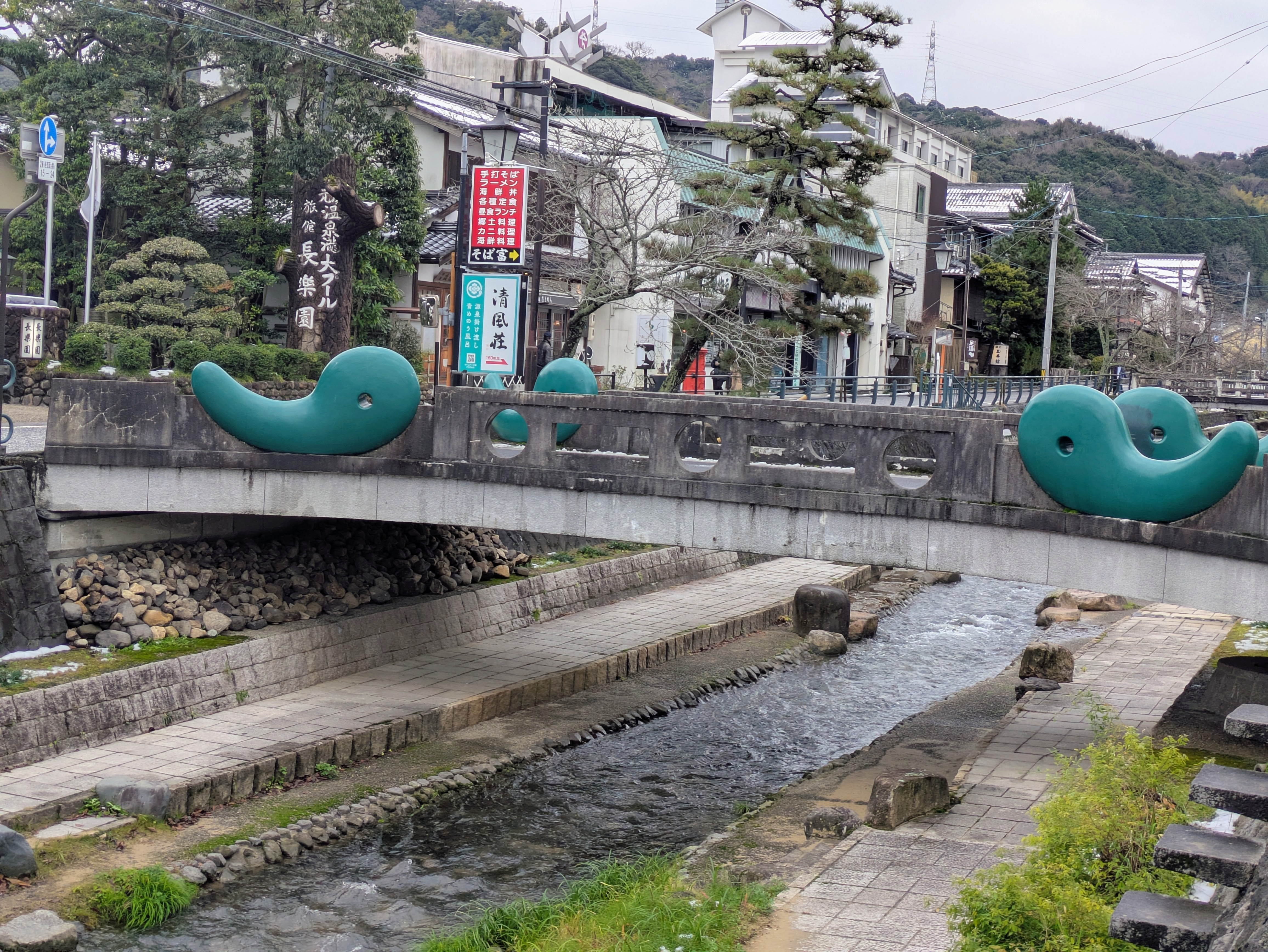


Known historically as the epicenter for producing Japan’s ancient “magatama” stone amulets, I first came to know about Tamatsukuri Onsen after speaking with a travel agency specializing in French guests coming to Japan.
“We always bring them to Tamatsukuri Onsen,” they said, and at first I was taken aback – after all, Shimane Prefectureis still very much an off-the-grid option for first timers in Japan. What was so special about this particular hot spring resort compared to others more easily accessible from cities like Tokyo and Kyoto? This newly discovered mystique coupled with my long-held fondness for magatama stones at long last led me to Tamatsukuri Onsen, a small hot spring town in Shimane Prefecture’s Matsue City.
How to Get to Tamatsukuri Onsen
Tamatsukuri Onsen is a part of Matsue City, Shimane Prefecture’s largest city. From Matsue Station, take the local train on the JR San’in Main Line to Tamatsukuri Onsen Station. The ride takes about 10 minutes and is covered by the JR Pass.
Once at Tamatsukuri Onsen Station, one can either walk about 20 minutes until reaching the town center or take a taxi (there were a few already waiting to pick up onsen-goers in front of the train station).
What to do in Tamatsukuri Onsen
Hime Labo


According to the ancient text, the “Izumo Fudoki,” Tamatsukuris waters are called the “hot spring of the gods.” Bathing once in Tamatsukuri Onsen’s waters makes skin beautiful while bathing twice cures disease. Overflowing with beautifying minerals such as sodium, calcium, sulfate, and chloride, Tamatsukuri’s hot springs are dubbed as Japan’s prized “bihada” (beautiful skin) waters. One study conducted in 2010 concluded that the waters here contain the highest proportion of moisturizing minerals among Japan’s natural hot springs, beckoning travellers with promises of firm and supple skin after one soak.
Some say the waters even feel like a natural lotion. Hime Labo, a local beauty company, offers a variety of cosmetics chock full of Tamatsukuri Onsen’s beneficial water minerals including hand creams, hot spring water mists, and face masks. One of their most popular products is the fluffy hand soap which can be tried in store!
Main shop: 1213 Tamayucho Tamatsukuri, Matsue, Shimane 699-0201
Art Box shop: 1241 Tamayucho Tamatsukuri, Matsue, Shimane 699-0201
Art Box


Art Box is a small shopping complex just at the entrance of Tamatsukuri Onsen’s town center. Renovated from an old inn, this charming traditional home now houses the local beauty brand Hime Labo on the first floor and adorable vintage knick-knack shops on the second! The small cafe overlooking the Tamayu River serves delicious burgers, drinks, and light snacks.
Location: 1241 Tamayucho Tamatsukuri, Matsue, Shimane 699-0201
Take a stroll down mythology lane


As the hot spring of the gods, Tamatsukuri Onsen is no stranger to Japanese mythology. The town’s main street running alongside the Tamayu River boasts several statues depicting scenes from Japan’s many traditional stories. One of the most famous of these stories is “Okuninushi and the Rabbit.”
Okunonishi was bullied by his brothers. One day, his brothers planned to travel to the Princess Yagami to ask for her hand in marriage. Poor Okuninushi had to follow them on their journey to carry all of their heavy luggage. As Okuninushi was catching up to his fast-paced brothers, he eventually saw a crying rabbit. When asked what was wrong, the rabbit explained to Okuninushi that he was trying to cross from Oki Island to the mainland. He had a plan to do so – he would trick the sharks of the sea with a competition.
He asked them to line up for a headcount to see if there were more rabbits or sharks. As the rabbit hopped on top of their bodies like stepping stones, he became too cocky and teased the sharks for falling for his trick. One of the sharks bit off his fur in anger. Okuninushi’s brothers found the rabbit and told him to wash his wounds in salt water. The poor rabbit innocently obeyed, but it made his wounds worse.
Overcome with compassion for the poor creature, Okuninushi told the rabbit to wash his body in fresh water and dry himself with cattails. The rabbit did as he was told and instantly his wounds were healed. The rabbit proclaimed that it would be his savior, Okuninushi, who would marry the princess. And it turned out, the rabbit’s prediction was correct! Okuninushi won over Princess Yagami with his kindness, overshadowing his cruel brothers despite his homely appearance.
Each mythology statue along the Tamayu River has a QR code beneath it with English translations for each story!
Yuyu Onsen

Yuyu Onsen is the town’s only public hot spring. Separated by gender, each side offers indoor and outdoor hot spring baths along with dry and mist saunas. The indoor baths on either side take a page out of Tamatsukuri Onsen’s history with quirky magatama stone designs. Relatively cheap massages within the 2,000~6,000 JPY range can be reserved on-site for either 30 or 60 minutes.
Location: 255 Tamayucho Tamatsukuri, Matsue, Shimane 699-0201
Himegami Square


A free hot spring foot bath and “omikuji” (paper fortunes) can be found at Himegami Square, fondly named after the deity Himegami, or Tamatsukuri Onsen’s very own “princess goddess” representing the hot spring’s beautifying qualities. Beside the footbath, there is a stand selling traditional Japanese omikuji fortunes written on paper. An ema plaque (prayer plaque) comes with each omikuji fortune for visitors to write their prayers on and hang at the display beside the princess goddess. There are ten different plaque designs you can receive with your omikuji fortune, including a rabbit like the character in Okunonishi’s story, Matsue Castle in the nearby downtown Matsue City, and a magatama stone amulet.
Location: 46 Tamayucho Tamatsukuri, Matsue, Shimane 699-0201
Menoya Shingu


Menoya Shingu is the best place in Tamatsukuri Onsen to get up close with the town’s iconic magatama stones. The very name “Tamatsukuri Onsen” (lit. stone making hot spring) alludes to the region’s millennia-long heritage of magatama production. Since Japan’s BC era, mountains nearby historically were rich in agate for creating magatama amulets. These stones were used as protection charms and jewelry. At Menoya Shingu, visitors can watch skilled magatama artisans in their workshop carving these amulets from stone. For a fee, visitors have the chance to do a DIY workshop to make their own.
Magatama are distinguished by their unique comma-like shape. Multiple theories persist regarding the origin of the magatama’s shape – some wonder if the shape mimics a predator’s teeth while others liken them to a human fetus. The magatama’s legacy in Japanese spirituality is so profound that Japan’s Three Sacred Treasures include the Yasakani Magatama along with the sword Kusanagi no Tsurugi and the mirror Yata no Kagami.
Tamatsukuriyu Shrine


A small treasure hall sits halfway up the stairs, holding hundreds of artifacts excavated from nearby magatama production sites. The treasure hall is normally closed to the public to protect the artifacts inside, but a visit to the shrine’s office can grant permission for access. Around the shrine grounds at the top, two sights in particular were very memorable. A rarity nowadays, Tamatsukuriyu Shrine has an intact dohyo for sumo wrestling matches. A dohyo is the circle where matches occur, and once one rikishi (sumo wrestler) stumbles beyond the dohyo circle, the match is over. While many sumo matches occur in stadiums, it is a living tradition of Shinto, Japan’s indigenous religion, and matches were also historically held at Shinto Shrines such as Tamatsukuriyu Shrine.
To the right of the shrine, a small boulder with a water spout is said to grant wishes, earning the name “negai ishi” (wish stone). Legend has it that shrine-goers who receive a complementary “kanai ishi” (granting stone) at the shrine office will have a wish come true if they follow these steps – purify the granting stone with water from the wish stone, lay it against the wish stone, write the wish on two provided wish slips, and leave one slip at the shrine.
Beside the shrine is a wonderful little tea room where after praying, a local grandma and grandpa serve up hot tea and traditional sweets. Tamatsukuri Onsen still does not get many international visitors, so they were curious where I was from, and we had a great chat over tea.
Location: 508 Tamayucho Tamatsukuri, Matsue, Shimane 699-0201
Izumo Tamatsukuri Museum & Park


With a bit of a stroll off the beaten path, the Izumo Tamatsukuri Museum sits atop a hill on the outskirts of town. The first floor houses an extensive display of magatama amulet artifacts and pottery. On the second floor, there is an impressive collection of Fujina Pottery, a distinct ceramics style from Tamatsukuri Onsen. Fujina Pottery is mainly known for its trademark yellow coloring, but other calming color combinations such as greens and blues are also common.
Just beside the museum across the street lies a small park with remnants of excavated magatama stone production sites, including a reconstructed craftsman home.
Location: 99-3 Tamayucho Tamatsukuri, Matsue, Shimane 699-0201